

Good analytics are critical when trying to understand how customers are actually interacting with your product. For many teams, Mixpanel is the first tool they reach for, and there are many excellent reasons for that. It offers incredible power and flexibility, in addition to many different features, as well. But as a company grows, so do its needs.
Pricing will often begin to seem more prohibitively expensive with the passage of time. Reports may get harder for non-technical teammates to use. Or maybe you just want something that fits your workflow better.
That’s where looking at Mixpanel alternatives makes sense.
Today, there’s no shortage of product analytics tools on the market. The challenge isn’t finding options; it’s figuring out which one actually works for your product and your team.
In this guide, we’ll walk through some of the best Mixpanel alternatives, compare how they stack up, and help you understand what each tool does well. Let’s begin with some basics.
What is Mixpanel?
Mixpanel is a product analytics platform for websites and mobile apps that helps you understand how users are interacting with your product and where they are dropping off.
Instead of just showing pageviews or traffic numbers, it focuses on actions, things like button clicks, sign-ups, feature usage, or drop-offs in a flow. This makes it especially useful for product, growth, and marketing teams that want to see what’s actually happening inside their app or website.
With Mixpanel, you can track events, build funnels, measure retention, and analyze user behavior over time. It’s widely used by SaaS companies and product-led teams because it offers deep insights and flexible reporting. That said, its advanced features can feel overwhelming for some users, and costs can rise quickly as data volumes grow. For many teams, those factors become the reason to explore other options.
In the next section, we have discussed the major reasons why people are searching for alyernatives of Mixpanel.
Read More: Target Market Analysis: What is it & How to Identify?
Why Businesses Look for Mixpanel Alternatives?
Mixpanel is a strong product analytics tool, but it’s not a perfect fit for every team. As companies grow, shift direction, or bring more people into the product decision-making process, they often realize that what worked early on no longer works as well. Here are some of the most common and very practical reasons businesses start exploring alternatives.
1. Pricing becomes harder to justify
At first, Mixpanel’s pricing may not raise any red flags, especially when your user base is still small. But as your product grows, so does the data you collect. More events, more users, more cost.
For many teams, that’s when the math starts to feel uncomfortable. You’re paying more every month, yet not always using the tool any differently than before. It often leads to a simple question: Are we actually getting enough value out of this to keep paying for it? For some businesses, that question alone is enough to start looking at alternatives that offer similar insights without the pressure of ever-increasing costs.

2. The learning curve slows teams down
As someone who does not have to use data every day, you may feel overwhelmed by how complex Mixpanel seems when you first log into the program. You’re expecting straightforward questions to be answered, such as “What actions did the user take?”, “Where did they leave?”, and all of a sudden, you are confronted with many charts and options that you are unsure of how to interpret.
For busy product managers, marketers, or founders, that extra friction gets frustrating fast. Instead of helping decisions move faster, the tool can start slowing things down. That’s when teams begin looking for analytics tools that are easier to understand and don’t require a tutorial every time someone wants to check a report.
Read More: 15 Best Social Media Analytics Tools Every Marketer Need
3. Setup and maintenance require ongoing effort
Setting up MixPanel properly is not a one-time task. Each new feature, change, or update to your product will result in you needing to revisit what you track and how you label the tracked data. If you maintain this regularly, your tracking data will remain fresh and retain its value. Unfortunately, many development teams spend the majority of their time actively managing their Mixpanel account as opposed to gaining insight from the data collected in Mixpanel.
Over time, that gets tiring, especially when it requires frequent help from developers. That’s why some businesses start looking for tools that work with less setup and don’t need constant attention to stay useful.
4. Not every team needs advanced analytics
If your goal is to understand basic user flows, feature adoption, or drop-off points, a simpler solution, such as Mixpanel, is likely to suffice. However, there are instances where you are paying for extra features, such as the ability to create unique cohort analyses or custom reporting, although you will likely never fully utilize these types of features. If this were to happen, you would likely feel less like you had downgraded from Mixpanel and more like you had found a solution that met your needs better.
5. Different teams want different insights
When companies grow in size, people become more reliant on product information. For instance, many marketing teams want insight into how their customers travel through the customer journey, and leadership teams are likely interested in a quick dashboard-style overview of certain relevant metrics during meetings. Overall, Mixpanel tends to work best for product-focused analysis, but it’s not always the easiest tool to share insights across departments.
6. Privacy, control, and compliance concerns
Business data privacy and the handling of sensitive consumer data are becoming a priority for organisations that collect sensitive consumer information (CRM, banking, finance, etc.) or operate within regulated sectors. As a result, some businesses wish to have more control over the method and location of storing data. Open-source and self-hosted alternatives thus can meet these priorities, which is another reason businesses look beyond Mixpanel.
In short, searching for a Mixpanel alternative doesn’t mean a company has outgrown analytics; it usually means they’re getting clearer about what they actually need. The right tool is the one that fits your team’s size, skills, budget, and goals, not just the one with the longest feature list. So, let’s explore the alternatives to Mixpanel.

Top 5 Mixpanel Alternatives that are Worth Checking Out
We have curated a list of some of the best Mixpanel alternatives out there, so you don’t have to spend hours on Google search results to find one. So without further ado, let’s dive straight in…
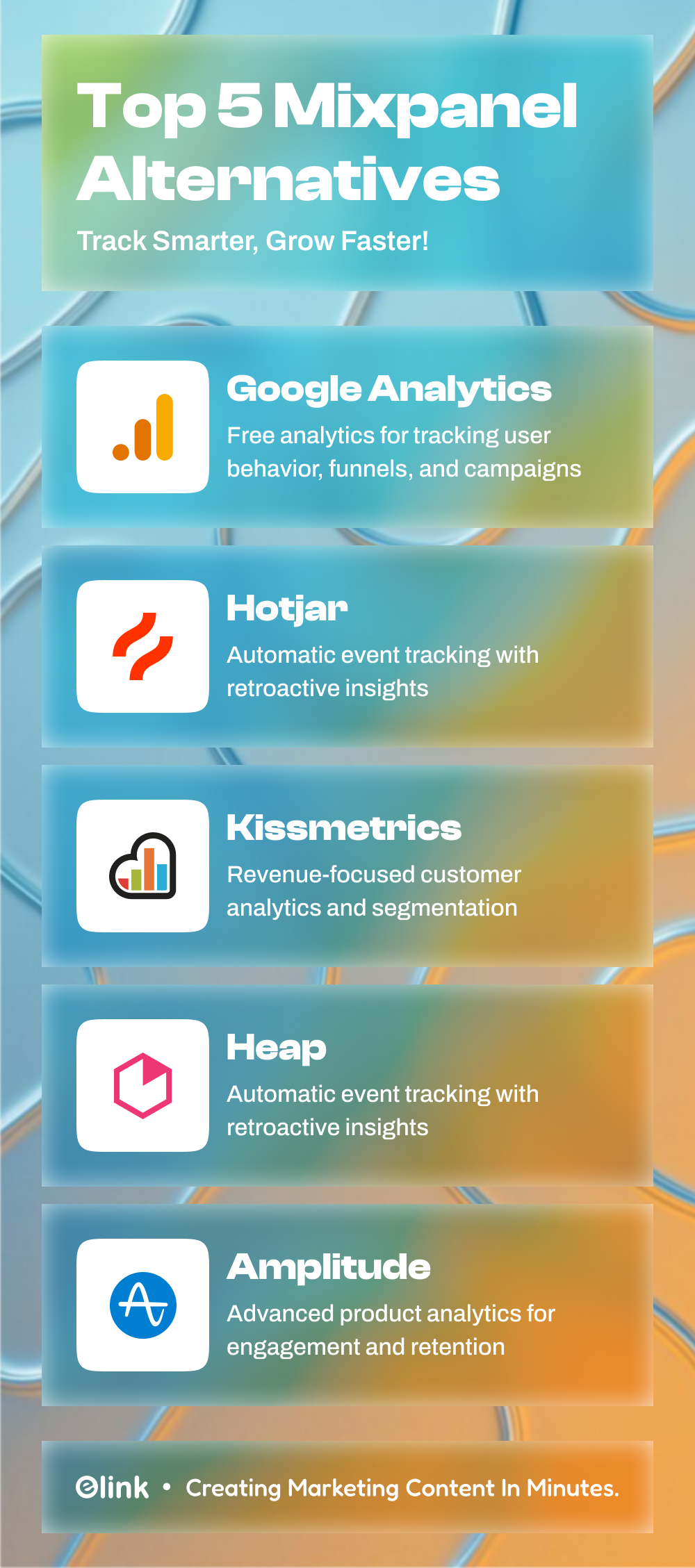
1. Google Analytics (GA4)
Kicking off our list is free to use and the most famous website analytics tool, Google Analytics. The go-to tool for the majority of people out there!
Google Analytics provides businesses with crucial data to better understand their site and app users and assess the performance of their marketing activities and conversion efforts. GA4, the latest version, focuses more on user behavior rather than just pageviews, making it more useful for modern, event-driven products.
GA4 provides organizations with insight into their users’ origins, user behavior, and the effectiveness of marketing strategies over time. The information collected from GA4 could be converted into in-depth reports for improved content, campaign, and conversion decisions. Although GA4 is not as product-oriented as Mixpanel, a lot of organizations use GA4 to supplement their use of Mixpanel, primarily where cost or ease is a concern for their organization.
Key Features
- Analyse how Users Interact with Websites and Mobile Applications
- The ability to track events with built-in custom goals for tracking events
- Path and funnel analysis will give you insights into your users’ journey.
- Live Reporting and Audience Insights
- Easy integration of Google Ads and other Google products.
Pricing:
- Free plan available
- Pro plan: Google Analytics 360 (custom pricing via sales)
2. Hotjar
A great Mixpanel alternative, Hotjar is a feature-heavy user analytics and conversion rate optimization tool. Hotjar makes it easy to see how users are interacting with your website or app and make changes to optimize the customer experience.
Heatmaps provide a visual overview of what your users do on your website/app by visually representing their clicks, taps, and scrolling behavior. You can also see visitor recordings and see where and when your users get stuck on your website.
Having this data is crucial to optimizing your conversion funnel, as you can see where and when visitors are dropping off and what can be done to prevent it.
You can also involve your website visitors in your optimization process by directly asking them questions via surveys, polls, and in-app feedback forms.
Key Features
- Heatmaps present click, tap, and scroll patterns (behaviour)
- Session Recordings allow for review of actual user interactions (experience)
- Funnel and Drop-off Analysis of the most important pages
- On-site surveys and feedback polls provide user feedbacks
- Rapid setup requiring little to no technical skill
Pricing:
- Free plan: Available with basic features
- Paid plans: Start at $40/month
Read More: How to Use Customer Feedback to Grow Your Business
3. Heap Analytics
Heap Analytics is frequently selected by those wanting to receive analytical information, rather than spending extensive time configuring tracking mechanisms before receiving this information. Because Heap captures all user activity automatically, organizations do not have to determine beforehand which events to track. For organizations with limited resources or time constraints, Heap’s automatic capture of all user activities may provide the organization with a considerable amount of saved time.
Heap lets you look back at user behavior and analyze actions after they’ve already happened, something that’s helpful when questions come up later. You can see how people move through your site or product, where they’ve hesitated to click, and which paths lead to conversions. This makes it easier to understand the journey of users without any need to constantly update tracking plans.
Key Features
- Automatic event tracking with no manual setup
- Retroactive analysis of user actions
- Funnel and journey tracking
- User segmentation and behavior insights
- Integrations with 3rd party tools like Slack and Salesforce
Pricing
- Free plan: Available with limited usage
- Paid plans: Based on data volume and team needs (custom pricing)
4. Kissmetrics
Another worthy Mixpanel alternative, Kissmetrics, is an easy-to-use customer analytics platform designed to help you close more sales.
Kissmetrics provides you with deep insights regarding how your visitors are interacting with your website, and then engages them with highly targeted email and Facebook campaigns.
With powerful customer segmentation and precision targeting, Kissmetrics never lets a visitor slip by your sales funnel. You can trigger behavior and attribute-based automated emails to keep customers engaged. You can also measure the email campaign’s impact to see what strategies drive sales.
With Shopify and WooCommerce integration, Kissmetrics allows you to import shopping history, segment customers, and target them with Facebook/Instagram campaigns or emails.
Key Features
- Behavior-based customer tracking
- Detailed user segmentation tied to revenue
- Email campaign tracking and attribution
- eCommerce integrations with Shopify and WooCommerce
- Funnel and conversion analysis
Pricing:
- Pricing starts from $25.99/month.
Read More: Customer Onboarding Emails:What Are They & How To Create Them?
5. Amplitude
The last one in the list is Amplitude, particularly for product-led groups. It is designed for analyzing user engagement with the product over time, factors that keep them engaged, factors that drive them away, and the actual product features that provide true value. They don’t measure the shallow end of metrics but rather drill down into user engagement and retention.
The platform makes it easier to follow users from their first interaction through key actions like activation, repeat usage, and conversion. Teams often use Amplitude to spot patterns across different user groups and understand what separates highly engaged users from those who leave early. While it’s powerful, it’s generally better suited for teams that are comfortable spending time exploring data and asking deeper product questions.
Key Features
- Tracking user activity with events across web and mobile
- Identifying weak spots and drop-offs in the conversion funnel
- Analysing retention through cohort analyses
- Utilising behavioural segmentation for greater understanding
- 360-degree dashboards and reports for your teams.
Pricing
- Free plan: Available with limited events and users
- Paid plans: Start around $49/month, scaling based on data usage
Final Thoughts
Mixpanel is a great platform to analyze customer behavior on your website and make data-driven decisions to foster growth. However, the Mixpanel alternatives mentioned above are all equally feature-rich. You cannot really go wrong with any of the above-mentioned tools; you just have to find the one that suits your business needs.
Did we miss out on your favorite Mixpanel alternative? Do let us know which behavioral analytics platform you use for your website or app by tweeting us @elink_io.
FAQs
What is a good alternative to Mixpanel?
A better alternative for Mixpanel would depend on whether one is more concerned with ease of use and setup requirements, whether one is concerned with visualization over charts, or whether one is concerned with product insights and retention analysis. Alternatively, some companies end up using a combination of tools for behavior analysis and user experience.
Heap might be a good option for ease of use and setup. Hotjar is a good option if one is concerned with visualization over charts. Amplitude might be the best option if one is concerned with product insights and retention analysis.
What are the top product analytics tools?
Some of the most widely used product analytics tools today include Amplitude, Heap Analytics, Mixpanel, Google Analytics 4 (GA4), Hotjar, and Kissmetrics. Each tool focuses on different strengths, such as product usage, funnels, retention, or customer behavior. The “top” tool is really the one that fits your product goals and team workflow.
Do Mixpanel alternatives offer cohort analysis?
Yes, many Mixpanel alternatives include cohort analysis. Tools like Amplitude and Heap allow you to group users in terms of behavior and help in tracking how those groups perform over time. This is especially helpful for understanding retention, feature adoption, and long-term engagement without relying solely on individual events.
Can Mixpanel competitors support A/B testing?
Some alternatives to Mixpanel allow performing A/B testing right inside the tool, while others integrate with testing tools. For example, user experience-oriented platforms like Hotjar allow you to understand why one variation outperforms another if the test itself was conducted elsewhere. In most scenarios, teams connect the analytics tool to a dedicated A/B testing platform for a more hassle-free setup.
Which Mixpanel alternative is best for customer behavior tracking?
Heap Analytics and Amplitude are strong options for clearly viewing step-by-step user behavior. Heap does a great job of automatically capturing user behavior, while Amplitude is second in terms of insight into users’ long-term patterns. For visual tracking in general, such as how users click, scroll, or have points of friction, Hotjar is a very practical choice.
Keep Reading & Learning 📚
Top 10 Mailchimp Alternatives You Must Try Out
14 Best Marketing Software to Grow Your Business