Email remains one of the most reliable ways to generate B2B sales leads, but only when done with the right approach. Actually, the challenge is that many businesses send out emails every day, yet struggle to see results because their strategy isn’t focused, clear, or up to date.
Success with email isn’t about sending as many messages as possible; it’s about delivering the right message to the right people at the right time.
That’s where a proven strategy makes all the difference. In this blog, we’ll share 10 practical techniques you can apply immediately to improve engagement and drive more B2B leads with emails. These aren’t generic tips; they’re tested methods that businesses of every size can use to get maximum conversions from emails.
So whether you’re new to email marketing or looking to fine-tune your current efforts, this guide will give you the clarity and direction to make every email truly count. Let’s first take a quick insight into B2B sales leads.
What are B2B Sales Leads?
Okay, let’s simplify this thing for you.
B2B sales leads are the potential customers for your business, but in the business-to-business world, those “customers” are usually other companies. More specifically, it’s the people inside those companies, like managers or decision-makers, who show interest in what you offer.
For example, let’s say you sell cloud storage. So, if an IT manager from another company fills out your form to learn more, that’s a B2B lead. They’re showing curiosity in your service, and with the right follow-up, they could become your customer.
So, in simple words, B2B leads are the starting point for new business relationships. Without them, there are no meetings, no deals, and no growth. They’re the foundation of every B2B company, whether you sell software, services, or physical products. Now, let’s move on to expert tips to get maximum B2B leads with emails.
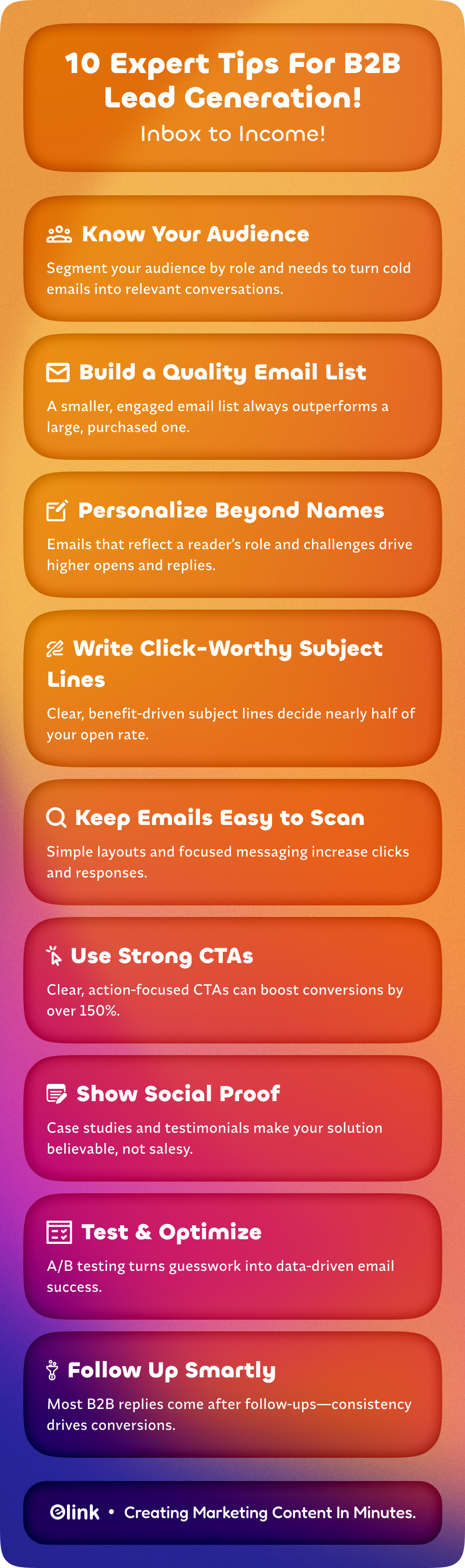
10 Expert Tips to Maximize B2B Sales Leads with Email
Instead of sending random emails and hoping for the best, here are 10 practical tips to help you get more B2B leads, better engagement, and stronger results from your emails. Let’s get started.
1. Understand Your Target Audience
Here’s the truth: the fastest way to make your emails irrelevant is to send the same message to everyone. Just think about it, would a CEO care about the same details as an IT manager? Probably not. A CEO may want to hear about ROI, cost savings, and long-term vision, while an IT manager is more interested in features, security, or ease of use.
That’s why knowing your audience is step one in maximizing B2B leads. The better you understand who you’re talking to, the easier it is to write emails for them that feel personal and useful.
When you take the time to understand your leads, your emails stop feeling like cold pitches and start feeling like genuine solutions to their problems. That’s when attention turns into interest, and interest turns into conversations.
📝 Quick Fact: Marketers who segment their audience and tailor messaging see a 760% increase in revenue from email campaigns.
Read more: B2B Newsletter: Monthly Plan to Build Trust and Drive Conversions
2. Build a Quality Email List
We’re going to tell you a big secret which many companies overlook: quality beats quantity every time when it comes to email lists. Yes, we know that many people would love to be able to purchase a large email list of contacts. But those lists often bring low-quality leads, spam complaints, and poor engagement.
That’s why you should focus on building your own email list slowly and steadily. This means collecting contacts who are genuinely interested in your business, usually through your website, webinars, downloads, or networking events. These leads are already warmed up; they’ve taken an action that shows curiosity or need in your products or services, making them much easier to nurture.
Some reports say that purchased lists often yield open rates as low as 2–5%, whereas organically built lists typically achieve much healthier 25–41% open rates, along with lower spam complaints and better metrics overall. So, think wisely before purchasing an email list.
Must Check: 10 Amazing Lead Magnet Ideas & Examples To Grow Your Email List
3. Personalize Your Email Content
No one likes receiving an email that sounds like it was written for a crowd of strangers. Well, when your messages feel generic or like copy-paste jobs, people just tune out or hit unsubscribe. But when you take just a little time to personalize the messages, it’s amazing how much more attention your emails grab.
When personalizing your emails, go beyond simply adding a name. Personalisation means showing recipients that you understand their role, their company’s goals, and the specific problems they are trying to solve. When your email reflects that level of understanding, it feels relevant and useful, not like a random message sent to everyone.
According to Adobe Business, emails with personalized subject lines get around 20% higher open rates than those without. So that tiny personalised tweak can make a big difference in getting more B2B leads.
4. Craft Clear and Catchy Subject Lines
Now comes the most interesting and tricky part of an email – Subject lines. Your subject line is like the headline of a news article; it’s the first thing people see, and it decides whether they open your email or scroll past it. You can think of it as your one shot to make a great first impression in a crowded inbox.
Here’s a fun fact: Studies show that 47% of people decide to open an email based solely on the subject line. That means almost half of your open rate depends on this tiny piece of text!
So, keep the subject lines short, clear, and interesting enough to make people curious. Avoid confusing or clickbaity subject lines that sound spammy; they’ll do more harm than good. Instead, focus on the benefit for the reader or spark a little curiosity that makes them want to learn more.
👉 For example, the subject line “Boost Team Productivity in 5 Minutes!” is an example of a clear subject line that clearly communicates to readers that inside the email are quick tips for increasing team productivity.
Contrast that with “You won’t believe what’s inside…” which sounds vague and might get flagged as spam.
Check These: Sales Email Subject Lines That Skyrocket Your Open Rates!
5. Optimize Email Design for Readability
Have you ever opened a really long email and your eyes just glazed over? Maybe you gave up halfway through or just skimmed so much that you missed the exact point of the email. It’s a common mistake that people make as they overload the reader with too much information. By doing this, you are pushing them away instead of drawing them in.
Think about it this way: people get dozens or even hundreds of emails a day. If yours is easy to scan and understand in just a few seconds, it’s more likely to get a positive response.
That’s why you keep your email focused on one main message. Whether you want them to book a call, download a guide, or RSVP to a webinar, make that action crystal clear. Use short sentences, break up your text with paragraphs or bullet points, and avoid jargon or complicated language.
👉 Here is a stat: emails with clear, simple messaging see a 23% higher click-through rate than those that are cluttered or confusing (Pepper Content).

6. Provide Real Value
Here’s the thing: if your emails only sound like sales pitches, your B2B leads will start tuning out fast. Well, no one likes to receive only salesy emails every time. That’s why you should aim to give something useful to your B2B customers with every email. That could be tips, insights, useful resources, industry news, or anything that genuinely helps your audience do their job better or solve a problem.
Because when you share real value, you build trust. And trust is critical in B2B sales because most decisions aren’t instant—they take time, multiple conversations, and confidence in your solution. And if your emails consistently help, your leads will remember you when they’re ready to buy.
👉 For example, let’s say you sell cybersecurity software. So, instead of just talking about your product, you might send an email with “5 Simple Ways to Protect Your Business from Phishing Attacks.” That’s valuable content that shows you understand their challenges, making it easier to start a conversation later.
7. Use Clear Calls-to-Action (CTA)
Now, every email that you send should end with a clear invitation to do something, whether it’s replying to your message, visiting your website, downloading a guide, or booking a demo. Your call-to-action (or CTA) is that friendly nudge that tells your reader exactly what you want them to do next.
But here’s the thing: if your CTA isn’t crystal clear or easy to find, most people won’t take any action at all. So, CTA is like telling people to “do something” without creating confusion and frustration.
👉 For example, instead of a vague “Learn More,” say “Download Your Free Guide” or “Schedule Your Free Demo Now.” Also, make your button or link stand out with a bright color and some space around it. And don’t overload your email with too many calls to action—one or two clear directions work best.
Research shows that using clear and specific CTAs can boost your conversion rates by as much as 161%. That’s a huge jump in the potential leads simply by telling people exactly what to do in a simple, straightforward way!
Read more: 10 Amazing Lead Magnet Ideas & Examples To Grow Your Email List
8. Include Social Proof and Case Studies
In B2B marketing, credibility is everything. When evaluating a business or product, B2B decision-makers look for proof of the performance of the product or service. That’s where social proof and case studies come in.
Showcasing client testimonials, industry-specific case studies, ROI numbers, before-and-after metrics, or success stories from similar businesses helps your leads visualize the impact your solution can create for their organization.
When prospects see how you’ve helped companies like theirs improve efficiency, reduce costs, or hit revenue targets, they’re far more likely to engage and move to the next stage of the sales funnel.
Remember: in B2B, proof beats promotion. Use it strategically, and watch your email conversions lift.
Read More: How to Write and Share Case Studies that Drive Results
9. Test and Analyze Your Campaigns
Now, one of the biggest secrets to getting better results from your B2B emails is simple: don’t just send and hope for the best. Instead, test different parts of your emails and then use the results to improve.
This could mean trying out two different subject lines to see which one gets more opens, testing two versions of your call-to-action button, or experimenting with the length of your email. It’s called A/B testing, and it’s like running mini-experiments to find what works best with your audience.
For example, you might send one group an email with a fun, casual subject line and another group a straightforward one. After a day or two, you check which group opened the email more and use that version moving forward.
So, by testing and analyzing your email campaigns regularly, you’ll learn what your leads respond to most, so every email gets better and better. It’s the best way to move from guessing what works to knowing for sure.
10. Follow-Up Strategically
Well, one email is rarely enough to turn a B2B lead into a customer. Most people need a few reminders before they’re ready to take the next step. That’s why sending a simple follow-up email sequence keeps the conversation alive without overwhelming your leads.
In fact, studies show that 70% of responses come from the 2nd to 4th follow-up emails. So don’t give up after just one or two emails, persistence always pays off!
👉 Quick summary: Successful email marketing isn’t about sending more emails, it’s about sending better ones. When your emails are clear, relevant, and helpful, they not only grab attention but also move leads closer to becoming customers.
Now, if you want to make your B2B emails smarter and save hours creating stunning, clickable newsletters, check out Elink.io. Elink is trusted by professionals, and it lets you build beautiful emails in minutes without any hassle. Let’s discuss more about Elink.io.
Make Your B2B Emails Smarter with Elink.io
So, if you want to save time while creating beautiful, professional emails that get noticed, Elink.io is a game-changer for you.
Elink.io is the smartest content curation tool designed to help busy professionals build stunning email newsletters and web content in minutes, no design skills needed.
Here’s why Elink.io is a standout choice for B2B marketers:
- Modern, Professional Templates: You can choose from over 50 clean and stylish template layouts. No matter whether you want a sleek grid or a simple list, there’s a template that fits your brand.
- Drag-and-Drop Editor: Easily customize your emails by dragging content blocks around. It’s simple, fast, and flexible.
- Content Curation Made Easy: Just paste URLs from articles, blog posts, videos, or products, and Elink.io magically turns them into beautiful content blocks—no more copying and pasting messy text.
- Automatic Updates: Connect RSS feeds or bookmarked pages, and your webpages update themselves with fresh content, perfect for keeping your emails fresh without extra effort.
- Seamless Integrations: Works flawlessly with Gmail, Mailchimp, Outlook, and popular email platforms so you can publish and send effortlessly.
- Chrome Bookmark Extension: Bookmark interesting content with the Chrome bookmark extension on the fly and easily add it to your newsletters later.
So, simply put, Elink.io turns the often complicated and time-consuming task of email creation into a quick, enjoyable process. It’s perfect for marketers, sales teams, freelancers, and anyone who wants to send smarter, more engaging B2B emails without breaking a sweat.
Visit Elink.io today and start creating yours.
Wrapping It Up
Well, at the end of the day, B2B email marketing is about quality, not quantity. So, focus on sending clear, relevant, and helpful emails that build real connections and guide your B2B leads toward becoming customers.
Also, use the tips in this blog to sharpen your email game and watch your B2B sales leads grow smarter, stronger, and more engaged.
FAQs
1. What are B2B sales, and how do they work?
B2B sales are when one business sells products or services to another. It usually involves multiple decision-makers and a longer process, focusing on building relationships and solving business needs.
2. How can B2B email marketing improve sales leads?
B2B email marketing helps in improving sales by sending targeted, personalized messages that engage potential clients. It builds trust and encourages B2B clients to take action, turning leads into customers.
3. Why is B2B email marketing important for lead generation?
It’s important because emails allow direct communication, helping businesses nurture relationships over time with relevant content that guides leads through the buying journey.
4. What is the best time to send B2B sales emails?
Typically, mid-week (Tuesday to Thursday) mornings between 9 AM and 11 AM are best, as decision-makers are more likely to open and respond during these times.
5. How do you write a high-converting B2B sales email?
Keep it clear and personalized—understand your audience, focus on one main message, include a compelling subject line and a strong call-to-action, and provide value that addresses their needs.
Keep Reading & Learning 📚
How to Build an Email List for Engaging Subscribers?
Best Lead Generation Software to Boost Your Sales!
How to Create High-Converting Lead Magnets That Drives Results
How to Use Customer Feedback to Grow Your Business
How to Create a Monthly Newsletter for Business: (Tips & Steps)